All abilities trek to the summit of Mount Kosciuszko - Australia's highest peak

All abilities trek to the summit of Mount Kosciuszko - Australia's highest peak
All abilities trek to the summit of Mount Kosciuszko - Australia's highest peak - © Jennifer Johnson 2008
Showing posts with label blind. Show all posts

Saturday, October 14, 2017

Three Charts on: Disability Discrimination in the Workplace

Three charts on: disability discrimination in the workplace
File 20171010 10864 1yj61lu.jpg?ixlib=rb 1.1
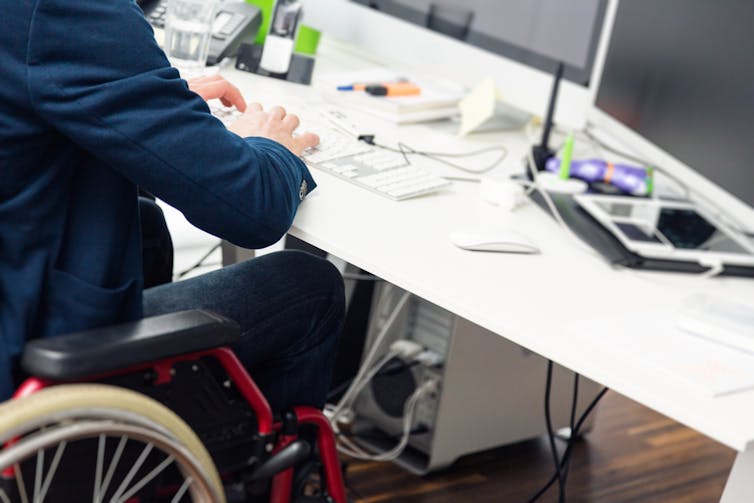
 Many workplaces do not make reasonable adjustments for employees with disability.: Shutterstock
               
Simon Darcy, University of Technology Sydney and Tracy Taylor, University of Technology Sydney

Only 53% of Australians with disability are employed, compared to 83% of all working-age people. Australia ranks 21st out of 29 OECD nations when it comes to employment rates for people with a disability.

But looking at the data reveals an even darker story – complaints about disability discrimination are the largest category of discrimination reported to the Australian Human Rights Commission (AHRC), and the numbers have been steady for around 20 years.

Lower employment levels translate into Australians with disability living in poverty at the highest rates in the OECD.

The Australian Bureau of Statistics also found that the employment rates vary radically depending upon the “disability type”. Those who have a “psychological disability”, for example, have the lowest employment rate at 29%.

Employment also varies by “disability severity” (defined as mild, moderate, severe and profound). Employment decreases as severity increases. Only 26% of people with profound or severe physical disability are employed.


As you can see in the chart above, complaints to the AHRC are categorised by the legislation they fall under – Disability Discrimination Act, Sex Discrimination Act, Racial Discrimination Act, Human Rights and Equal Opportunity Commission Act, and Age Discrimination Act.

Using this, we can see that disability discrimination has consistently represented the highest proportion of complaints, currently 37%. When you consider that the Racial Discrimination Act and the Sex Discrimination Act total 41% of cases combined, this gives some insight into the prevalence of workplace discrimination faced by people with disability.

The next chart shows the proportion of disability discrimination complaints that relate to the workplace. This is approximately 35% from the latest figures but  has peaked at a much higher rate.

While we can’t explain the fluctuation, at various times there have been changes to the system, cuts in funding and political tensions. What can be interpreted from the figures is that disability discrimination has been sustained and ongoing over the two decades.


In our research, using publicly available complaint case summaries, we found that employers incorrectly assumed that the costs of employing people with disability were higher than they are, or were unaware of government programs to offset the costs of reasonable adjustments in the workplace. In other cases, people were discriminated against by the strict adherence to guidelines and policies. 

We found several distinctive themes in the disability complaints made.

For instance, many employers do not provide adequate access to the workplace. This could be as simple as tactile ground surfaces for people who are blind. Many cases also involved managers, or human resource procedures, being too quick to dismiss an employee who acquired a disability. Reasonable adjustments can often be made to the position descriptions.

Hiring practices were often biased and discounted the abilities of applicants (otherwise known as unconscious bias). In many cases, workplaces were not inclusive of assistive technologies, such as screen reading software or hearing loops. These would have allowed employees with a disability to do their job.

Mental health complaints have doubled in prevalence over time suggesting the dynamic nature of disability discrimination and the willingness of those with mental health issues to disclose their disability who previously may not have instigated a complaint case.


In reading the summaries of the complaints to the AHRC, it is apparent that employers, co-workers and third-party organisations (e.g. insurance companies) directly or indirectly treat people unfairly, or, in the worst cases, display open hostility to Australians with a disability.

In doing so, those involved show a lack of understanding of the basic legal principles of the Disability Discrimination Act. These include sections covering direct discrimination, indirect discrimination, unjustifiable hardship, inherent requirements and reasonable adjustments.

What can be done?


Some may argue that Australians with severe levels of disability would be unable to work. But their experiences show that, with the correct assistive technology and attitudes that focus on ability rather than disability, employment is not just possible but imperative. 

A recent OECD report singled out Denmark and Switzerland for their targeted intervention for younger people with disability or medical conditions. This ensures they have the highest chances of being employed rather than becoming welfare-dependent.

The foundation of the National Disability Insurance Scheme shows the government’s desire to give people with disability the opportunity to move from welfare to employment. While we wait for the major policy change to take effect, other immediate options are available to bring about positive social change.

Positive exposure in the media (see Attitude Foundation), personal contact and education could change attitudes to disability. The government and non-profit organisations have a multitude of resources available for businesses, to raise awareness about best practice and inclusive assistance.

One good resource is Job Access. This government site provides education and resources to assist with workplace adjustment. It also provides direct assistance to people with disability.

The ConversationOther organisations like the Australian Network on Disability can help businesses to become strategically more inclusive. In the end it will come down to employers giving every Australian job seeker with disability a fair go and not judging “what I can do by what you think I can’t”.

Simon Darcy, Professor of Social Inclusion - UTS Business School - Centres for Business and Social innovation, and Business Intelligence and Data Analytics, University of Technology Sydney and Tracy Taylor, Professor of Sport Management, University of Technology Sydney

This article was originally published on The Conversation. Read the original article.


An article based on work we undertook on the Australian Human Rights Commission's complaint case and conciliation outcomes.
Darcy, S., Taylor, T., & Green, J. (2016). ‘But I can do the job’: examining disability employment practice through human rights complaint cases. Disability & Society, 31(9), 1242-1274. http://www.tandfonline.com/doi/full/10.1080/09687599.2016.1256807
The Conversation

Sunday, March 5, 2017

United Nations World Tourism Organization develops policy and manuals on accessible tourism


For those who may not be aware the United Nations World Tourism Organization together with contributing organisations and individuals have developed and published a set of resources to assist destinations in developing accessible tourism information, marketing, products and services.

The resources draw on the best academic, industry and policy practice from around the world with impetus gained from the San Marino Declaration on Accessible Tourism and the subsequent UNWTO recommendations on accessible tourism.

Hopefully all manuals will eventually appear in English as well as Spanish.

The remainder of the page is reprinted from http://ethics.unwto.org/en/content/accessible-tourism 
=====================================
The front cover of the UNWTO manual on accessible Tourism for All showing a heritage building
UNWTO Recommendations on Accessible Tourism
The UNWTO Recommendations on Accessible Tourism for All are meant to be used as a general, basic mainstreaming framework for ensuring that people with disabilities have access to the physical environment, the transportation system, information and communications channels, as well as to a wide range of public facilities and services. 
The Recommendations incorporate the most relevant aspects of the UN Convention on the Rights of People with Disabilities of 2006 and the principles of Universal Design.
In the context of a trilateral agreement between UNWTO, ONCE and ENAT, the recommendations were adopted by UNWTO General Assembly Resolution A/RES/637(XX) of August 2013, updating the 2005 UNWTO Recommendations. 
Read the Recommendations in English Español Français

Manuals on Accessible Tourism for All
One of the most significant outcomes of a major collaboration framework between UNWTO and disabled people’s organizations (DPOs), particularly the Spanish ONCE Foundation for the Cooperation and Social Inclusion of People with Disabilities, the European Network for Accessible Tourism (ENAT), and the Spanish ACS Foundation, are the Manuals on Accessible Tourism for All.
The manuals are meant to assist tourism stakeholders in improving the accessibility of tourism destinations, facilities and services worldwide.
Manual on Accessible Tourism for All: Public-Private Partnerships and Good Practices
Full text: English  Spanish   Executive SummaryEnglish Español Français
The first tangible outcome of a fruitful collaboration between the UNWTO and the ACS Foundation features the inclusion of both cultural and natural heritage assets into the accessible tourism value chain as well as the technical knowledge necessary for making tourism infrastructures and attractions accessible to all. The English translation of the Spanish original was published in January 2015. The Publication been laid-out following the Web Content Accessibility Guidelines (WCAG) 2.0 (level AA)

Manual on Accessible Tourism for All: Principles, Tools and Good Practices 
Executive Summary (of all five Modules): English Español Français
1.Manual on Accessible Tourism for All: Principles, Tools and Good Practices,  Module I
Full text: Spanish 
UNWTO's second publication on universal accessibility has been co-produced with the Spanish ONCE Foundation for social inclusion of people with disabilities and the European Network for Accessible Tourism - ENAT. Module I is currently available in Spanish only, in a digital accessible version. It has been laid-out following the Web Content Accessibility Guidelines (WCAG) 2.0 (level AA). 

2.Manual on Accessible Tourism for All: Principles, Tools and Good Practices,  Module II
Full text: Spanish 
Module II of the Manual on Accessible Tourism for All: principles, tools and best practices suggests specific recommendations targeting the tourism sector with the aim of creating accessible tourism destinations. The proposed actions are based on the need to respect the integrity of the entire value chain of a tourist experience when implementing universal accessibility plans, and thus cover the five main areas of the same: planning and information, transportation, accessibility of the natural and built environments, shared public spaces and specific spaces. It is essential that people with disabilities and special needs complete their travel experience without any obstacles like all the other tourists. Module II is currently available in Spanish only, in a digital accessible version. It has been laid-out following the Web Content Accessibility Guidelines (WCAG) 2.0 (level AA). 

3.Manual on Accessible Tourism for All: Principles, Tools and Good Practices, Module III
Full text: Spanish
Module III of the Manual on Accessible Tourism for All: principles, tools and best practicesco-produced with the ONCE Foundation and ENAT, highlights the necessary actions that need to be undertaken in order to make the universal accessibility in tourism a reality. These actions should result from an overall policy framework and specific strategies fostering Accessible Tourism which are being discussed in this module. The policy framework should provide the basis for proper planning and development of strategic areas of intervention, such as legislation, awareness-raising and training, research, as well as marketing and management of accessible tourism. Module III is currently available in Spanish only, in a digital accessible version. It has been laid-out following the Web Content Accessibility Guidelines (WCAG) 2.0 (level AA). 

4.Manual on Accessible Tourism for All: Principles, Tools and Good Practices, Module IV
Full text: Spanish
Module IV of the Manual on Accessible Tourism for All: Principles, Tools and Best Practices, co-produced with the ONCE Foundation and ENAT, proposes a series of indicators developed for tourism destinations to assess, control, and manage their accessible tourism offer. Accompanied by a detailed methodology for their application, these indicators can serve as a practical tool not only to assess the current situation within destinations but also to consider further actions that may be required. Module IV is currently available in Spanish only, in a digital accessible version. It has been laid-out following the Web Content Accessibility Guidelines (WCAG) 2.0 (level AA). 

5.Manual on Accessible Tourism for All: Principles, Tools and Good Practices Module V  NEW!
Full text: Spanish
Module V of the Manual on Accessible Tourism for All: principles, tools and best practices, co-produced with the ONCE Foundation and ENAT, provides an overview of case studies and good practices which have proven a successful implementation of universal accessibility in different spheres of tourism, such as promotion, market research, travel agencies, transportation, accommodation, training & capacity building and destination management. The examples featured therein analyze a wide spectrum of conditions which were decisive in making accessible tourism a reality and are meant to inspire the key stakeholders to engage in similar initiatives in their respective areas of influence.  Module V is currently available in Spanish only, in a digital accessible version. It has been laid-out following the Web Content Accessibility Guidelines (WCAG) 2.0 (level AA). 

San Marino Declaration on Accessible Tourism 
The Declaration which resulted from the 1st UNWTO Conference on Accessible Tourism in Europe, held on 19-20 November 2014 in the Republic of San Marino, can be downloaded here:

Relevant UNWTO Events and Reports on Tourism and Accessibility 

Saturday, December 3, 2016

New article- Inclusive by Design: Transformative Services and Sport Event Accessibility

Originally published at Dickson, T. J., Darcy, S., Johns, R., & Pentifallo, C. (2016). Inclusive by Design: Transformative services and sport-event accessibility The Services Industry Journal, 36(11-12) pp532-555. Article available for no charge athttp://www.tandfonline.com/eprint/WdSae6GJGPG7rNXBV9qh/full 


FIFA Women's World Cup 2015 Canada

Quote from abstract:
This paper examines the service dimensions required to be inclusive of people with access needs within a major-sport event context. The United Nations Convention on the Rights of Persons with Disabilities seeks to counter disability discrimination and enable citizenship rights of people with disabilities, including access to goods and services, across all dimensions of social participation including major-sport events (e.g. Olympic and Paralympic Games, world cups in football, cricket and rugby union). Providing for people with disability and access needs is also an emerging tourism focus with initiatives addressing accessible tourism included in the World Tourism Organizations mission and recent strategic destination plans. To enhance the understanding of service delivery for an accessible tourism market in a major-sport event context, a case study of the Vancouver Fan Zone for the FIFA Womens World Cup Canada, 2015 TM is analyzed through the lens of transformative services. From this analysis future research directions are identified to benefit those with access needs who wish to participate in major-sport events.

Photo 1: signage and wayfinding is so important at major events particularly where temporary overlays are used -photo courtesy of Dr Tracey Dickson ©2015.


The paper uses service blueprinting and a "traffic light" approach to assessing the fan experience from a disability perspective. Table 3 from the document is provided to give an understanding of the approach. The font and colours are explained as  Normal font or green = OK; Italics =or yellow = caution; Bold or orange = problem. The colours chosen were recommended to support screen readers.

Table 3 Traffic light service blueprint: assessment of stages of Fan Zone experience
STAGES
EVIDENCE
MOBILITY
VISION
HEARING
COGNITIVE
Research and planning
Websites (FIFA; Vancouver City)
No accessibility information for Fan Zone. Links to accessible transport information
FIFA Website not fully WCAG 2.0 compliant
No accessibility information for Fan Zone
Travel
Websites (FIFA;  Transit), Access Audit; observation
Public transport is accessible for independent travel
 HandyDART available for other support
Transit website is not fully WCAG 2.0 compliant
Buses and trains have LED signs indicating next stop
HandyDART available for other support
Arrival
Access Audit; Observation, photo analysis
Clear path of travel
No tactile tiles
Signage is clear
Only one entry
Activations
Access Audit; Observation, photo analysis
No overt mobility support or participation opportunities
No braille information; noise levels too high to hear instructions. Most activations assume vision
No written information available for instructions
Noisy, crowded
Food and Beverages
Access Audit; Observation, photo analysis
All vendor trucks serving areas inaccessible to wheelchair users. 3 step process to buy alcoholic drinks not helpful for those with mobility needs
No braille information, but servers can speak to customers
Signage is clear
Typical lining up process, but no guidance about where/how to line up
Toilets
Access Audit; Observation, photo analysis
Unisex accessible portable toilets available in unisex toilet area
No braille information. No staff nearby to give directions
Signage is clear
Standard port-a-loos, but in unisex layout
Watching matches
Access Audit; Observation, photo analysis
Iterations of accessible viewing not appropriate; no crowd management to support viewing
Sound system not clear. No match commentary
No hearing loops
No subtitles on screen. No sign language for MC
No ticketing, reserved seats or spaces.
Leaving & emergency exits
Access Audit; Observation, photo analysis
Clear path of travel
No tactile tiles. Sound system did not cover all Fan Zone area if emergency exit info needed, but there were security staff and volunteers
Signage is clear; security staff and volunteers available
One main exit clearly marked; security staff and volunteers available


Monday, November 28, 2016

Seminar on Measuring Destination Competitiveness, Sustainability and Accessibility in Tourism

Masters research candidate Ana Rucci, from the National University of La Plata Argentina, showcased her research on accessibility in tourism at a talk for the UTS Business School, University of Technology Sydney on 17 November 2016. Ana's research aims to develop a uniform methodology that could measure accessibility in tourism as a competitiveness factor across different countries.
Destination competitiveness and sustainability (Ritchie and Crouch, 2003) is a robust framework used by academics and industry to identify competitive advantage by nation states. In 2016 the World Tourism Organization recognised the growing importance of accessible tourism as a commitment to their charter on universally accessible tourism products and services, however, what constitutes accessibility for destinations remains largely unexplored.

Case studies from Argentina and Brazil were a particular focus point in the preliminary findings Ana presented, as the recent FIFA World Cup and Olympic and Paralympic Games boosted tourism in the area while incorporating issues involving accessibility for the host nation and cities. By contrasting these examples in relationship to findings from Australia and New Zealand, Ana's research builds on an examination of overarching tourism destination competitiveness from a disability and accessibility perspective.
Photo 1: Ana Rucci & Prof Simon .Darcy at the UTS Business School

Ana's presentation was part of a larger research project that Ana, Dr Natalia Porto (also from the National University of La Plata Argentina), and Professor Simon Darcy from UTS Business School are undertaking on global accessible tourism metrics and policy.

Seminar on Measuring Destination Competitiveness, Sustainability and Accessibility in Tourism


Masters research candidate Ana Rucci, from the National University of La Plata Argentina, showcased her research on accessibility in tourism at a talk for the UTS Business School, University of Technology Sydney on 17 November 2016. Ana's research aims to develop a uniform methodology that could measure accessibility in tourism as a competitiveness factor across different countries.
Destination competitiveness and sustainability (Ritchie and Crouch, 2003) is a robust framework used by academics and industry to identify competitive advantage by nation states. In 2016 the World Tourism Organization recognised the growing importance of accessible tourism as a commitment to their charter on universally accessible tourism products and services, however, what constitutes accessibility for destinations remains largely unexplored.

Case studies from Argentina and Brazil were a particular focus point in the preliminary findings Ana presented, as the recent FIFA World Cup and Olympic and Paralympic Games boosted tourism in the area while incorporating issues involving accessibility for the host nation and cities. By contrasting these examples in relationship to findings from Australia and New Zealand, Ana's research builds on an examination of overarching tourism destination competitiveness from a disability and accessibility perspective.
Photo 1: Ana Rucci & Prof Simon .Darcy at the UTS Business School

Ana's presentation was part of a larger research project that Ana, Dr Natalia Porto (also from the National University of La Plata Argentina), and Professor Simon Darcy from UTS Business School are undertaking on global accessible tourism metrics and policy.

Monday, May 16, 2016

Australia - New South Wales Ministerial Forum On Accessible Tourism Strategy Development


On Wednesday 11 May 2016 a New South Wales Ministerial Forum on Accessible Tourism was held at NSW Parliament House in the Strangers Room. Building upon the work by NSW Family and Community Services (FACS) on inclusive communities over the last two years, the Ministerial Forum was held to reflect on past approaches and future opportunities with the impending NDIS for accessible tourism in NSW. Organised by NSW FACS and facilitated by the University of Technology Sydney’s Institute for Public Policy and Governance, the forum was opened by the Minister for Disability Services and Multiculturalism the Honourable John Ajacka. The format for the day included two forums. The first forum was chaired by Donna Rygate the CEO of Local Government NSW with the purpose of reflecting on past initiatives that had worked well. With the background of the NSW Disability Inclusion Act 2014, Donna outlined the opportunities and potential for developing inclusive communities and accessible tourism at the local government level. She stressed the importance that an inclusive community is also a great community to visit as a tourist. The panel consisted of Martin Heng, the accessible travel manager and editorial advisor for Lonely Planet, Dr Helen Margarita Smith - the bush walking program office of the National Parks Association of NSW, and Sean Willenberg – Disability Inclusion Officer, NSW Business Chamber. The overriding outcome of the first forum was the importance of information provision and information systems so that consumers can make an informed choice about tourism product offerings. This was also supported through the discussion with the audience that people with disabilities and others with access needs want great accessible destination experiences and don't travel hundreds or thousands of miles to stay in hotels/other forms of accommodation. The second panel was chaired by Prof Simon Darcy, UTS Business School who presented recent European research undertaken by the EU and the UN World Tourism Organisation. This research work reinforced a great deal of similar findings from the US, the UK and Australasia (see references), with Prof Darcy concluding that the time for research was over and a knowledge base existed for industry action to improve the tourism citizenship of people living in NSW or visiting it from other states or overseas. The other members on the panel were Geoff Buckley - ex-head of Tourism Australia and Managing Director of New Earth Tourism, Andrew Bowring -Business Head of Zomato, and Jenny Spinak, Access Manager of the Sydney Opera House. Discussions on this panel examined the opportunities for engaging an industry led supply side digital platforms across travel information, accommodation, attractions, restaurants/bars and the share economy. Jenny Spinak also shared experiences of the importance of driving cultural change with internal and external stakeholders of organisations and provided examples of the successful transition of the Sydney Opera House to an organisation embracing inclusion and receiving a multitude of benefits including increased patronage, corporate social responsibility outcomes and opportunities for sponsorship. After each session lively discussions were held with the approximately 50 people in attendance from the tourism industry, disability advocacy and government sectors. The outcome of the forum is to produce an action plan for NSW to facilitate accessible tourism opportunities across the state including rural and remote areas. The Institute for Public Policy and Governance provided background papers and will be working on an action plan agenda arising from the meeting. For further information please contact Ivan Pavkovic Ivan.Pavkovic@uts.edu.au

Photo 1. Bill Forrester of Travability posing a question for Donna Rygate of the NSW Local Government and Shires Association

References
Buhalis, D., & Darcy, S. (Eds.). (2011). Accessible Tourism: Concepts and Issues. Bristol, UK: Channel View Publications.
Buhalis, D., Darcy, S., & Ambrose, I. (Eds.). (2012). Best Practice in Accessible Tourism: Inclusion, Disability, Ageing Population and Tourism. Bristol, UK: Channel View Publications.
Dwyer, L., & Darcy, S. (2011). Chapter 14 - Economic Contribution of Tourists with Disabilities: An Australian Approach and Methodology. In D. Buhalis & S. Darcy (Eds.), Accessible Tourism: Concepts and Issues (pp. 213-239). Bristol, UK: Channel View Publications.
GFK, University of Surrey, Neumann Consult, & Pro A Solutions. (2015). Economic Impact and Travel Patterns of Accessible Tourism: European Commission in conjunction with GFK - University of Surrey - Neumann Consulting - Pro A Solutions.
Michopoulou, E., Darcy, S., Ambrose, I., & Buhalis, D. (2015). Accessible tourism futures: the world we dream to live in and the opportunities we hope to have. Journal of Tourism Futures, 1(3), 179-188.
Open Doors Organization. (2015). Research among Adults with Disabilities: Travel and Hospitality (USA). Chicago: Open Doors Organization.
UNWTO. (2015a). Manual on Accessible Tourism for All: Principles, Tools and Good Practices - Module 1   Retrieved from http://www.e-unwto.org/doi/book/10.18111/9789284416486
UNWTO. (2015b). Manual on Accessible Tourism for All: Principles, Tools and Good Practices - Module 2   Retrieved from http://www.e-unwto.org/doi/abs/10.18111/9789284416509
UNWTO. (2015c). Manual on Accessible Tourism for All: Principles, Tools and Good Practices - Module 3   Retrieved from http://www.e-unwto.org/doi/book/10.18111/9789284416523
UNWTO. (2015d). Manual on Accessible Tourism for All: Principles, Tools and Good Practices - Module 4   Retrieved from http://www.e-unwto.org/doi/abs/10.18111/9789284416547
UNWTO. (2015e). Manual on Accessible Tourism for All: Principles, Tools and Good Practices - Module 5   Retrieved from http://www.e-unwto.org/doi/pdf/10.18111/9789284416585
UNWTO. (2015f). Manual on Accessible Tourism for All: Public-private Partnerships and Good Practices   Retrieved from http://www.e-unwto.org/doi/pdf/10.18111/9789284416585

Total Pageviews

Popular Posts

Labels