All abilities trek to the summit of Mount Kosciuszko - Australia's highest peak

All abilities trek to the summit of Mount Kosciuszko - Australia's highest peak
All abilities trek to the summit of Mount Kosciuszko - Australia's highest peak - © Jennifer Johnson 2008
Showing posts with label Deaf. Show all posts

Saturday, October 14, 2017

Three Charts on: Disability Discrimination in the Workplace

Three charts on: disability discrimination in the workplace
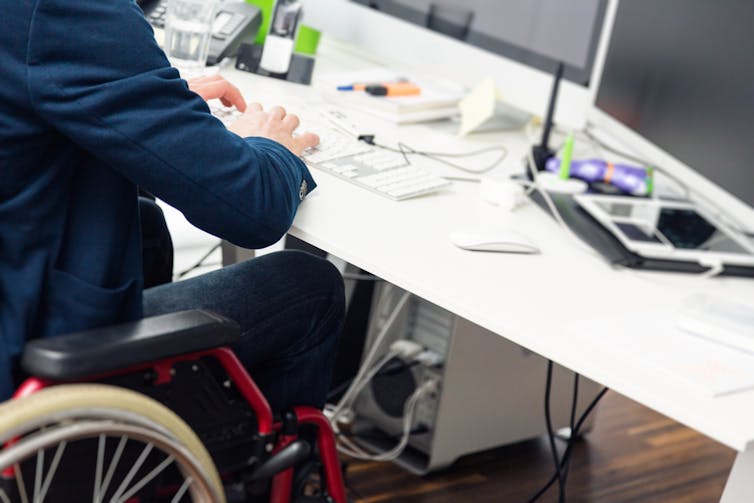
File 20171010 10864 1yj61lu.jpg?ixlib=rb 1.1
 Many workplaces do not make reasonable adjustments for employees with disability.: Shutterstock
               
Simon Darcy, University of Technology Sydney and Tracy Taylor, University of Technology Sydney

Only 53% of Australians with disability are employed, compared to 83% of all working-age people. Australia ranks 21st out of 29 OECD nations when it comes to employment rates for people with a disability.

But looking at the data reveals an even darker story – complaints about disability discrimination are the largest category of discrimination reported to the Australian Human Rights Commission (AHRC), and the numbers have been steady for around 20 years.

Lower employment levels translate into Australians with disability living in poverty at the highest rates in the OECD.

The Australian Bureau of Statistics also found that the employment rates vary radically depending upon the “disability type”. Those who have a “psychological disability”, for example, have the lowest employment rate at 29%.

Employment also varies by “disability severity” (defined as mild, moderate, severe and profound). Employment decreases as severity increases. Only 26% of people with profound or severe physical disability are employed.


As you can see in the chart above, complaints to the AHRC are categorised by the legislation they fall under – Disability Discrimination Act, Sex Discrimination Act, Racial Discrimination Act, Human Rights and Equal Opportunity Commission Act, and Age Discrimination Act.

Using this, we can see that disability discrimination has consistently represented the highest proportion of complaints, currently 37%. When you consider that the Racial Discrimination Act and the Sex Discrimination Act total 41% of cases combined, this gives some insight into the prevalence of workplace discrimination faced by people with disability.

The next chart shows the proportion of disability discrimination complaints that relate to the workplace. This is approximately 35% from the latest figures but  has peaked at a much higher rate.

While we can’t explain the fluctuation, at various times there have been changes to the system, cuts in funding and political tensions. What can be interpreted from the figures is that disability discrimination has been sustained and ongoing over the two decades.


In our research, using publicly available complaint case summaries, we found that employers incorrectly assumed that the costs of employing people with disability were higher than they are, or were unaware of government programs to offset the costs of reasonable adjustments in the workplace. In other cases, people were discriminated against by the strict adherence to guidelines and policies. 

We found several distinctive themes in the disability complaints made.

For instance, many employers do not provide adequate access to the workplace. This could be as simple as tactile ground surfaces for people who are blind. Many cases also involved managers, or human resource procedures, being too quick to dismiss an employee who acquired a disability. Reasonable adjustments can often be made to the position descriptions.

Hiring practices were often biased and discounted the abilities of applicants (otherwise known as unconscious bias). In many cases, workplaces were not inclusive of assistive technologies, such as screen reading software or hearing loops. These would have allowed employees with a disability to do their job.

Mental health complaints have doubled in prevalence over time suggesting the dynamic nature of disability discrimination and the willingness of those with mental health issues to disclose their disability who previously may not have instigated a complaint case.


In reading the summaries of the complaints to the AHRC, it is apparent that employers, co-workers and third-party organisations (e.g. insurance companies) directly or indirectly treat people unfairly, or, in the worst cases, display open hostility to Australians with a disability.

In doing so, those involved show a lack of understanding of the basic legal principles of the Disability Discrimination Act. These include sections covering direct discrimination, indirect discrimination, unjustifiable hardship, inherent requirements and reasonable adjustments.

What can be done?


Some may argue that Australians with severe levels of disability would be unable to work. But their experiences show that, with the correct assistive technology and attitudes that focus on ability rather than disability, employment is not just possible but imperative. 

A recent OECD report singled out Denmark and Switzerland for their targeted intervention for younger people with disability or medical conditions. This ensures they have the highest chances of being employed rather than becoming welfare-dependent.

The foundation of the National Disability Insurance Scheme shows the government’s desire to give people with disability the opportunity to move from welfare to employment. While we wait for the major policy change to take effect, other immediate options are available to bring about positive social change.

Positive exposure in the media (see Attitude Foundation), personal contact and education could change attitudes to disability. The government and non-profit organisations have a multitude of resources available for businesses, to raise awareness about best practice and inclusive assistance.

One good resource is Job Access. This government site provides education and resources to assist with workplace adjustment. It also provides direct assistance to people with disability.

The ConversationOther organisations like the Australian Network on Disability can help businesses to become strategically more inclusive. In the end it will come down to employers giving every Australian job seeker with disability a fair go and not judging “what I can do by what you think I can’t”.

Simon Darcy, Professor of Social Inclusion - UTS Business School - Centres for Business and Social innovation, and Business Intelligence and Data Analytics, University of Technology Sydney and Tracy Taylor, Professor of Sport Management, University of Technology Sydney

This article was originally published on The Conversation. Read the original article.


An article based on work we undertook on the Australian Human Rights Commission's complaint case and conciliation outcomes.
Darcy, S., Taylor, T., & Green, J. (2016). ‘But I can do the job’: examining disability employment practice through human rights complaint cases. Disability & Society, 31(9), 1242-1274. http://www.tandfonline.com/doi/full/10.1080/09687599.2016.1256807
The Conversation

Sunday, March 5, 2017

United Nations World Tourism Organization develops policy and manuals on accessible tourism


For those who may not be aware the United Nations World Tourism Organization together with contributing organisations and individuals have developed and published a set of resources to assist destinations in developing accessible tourism information, marketing, products and services.

The resources draw on the best academic, industry and policy practice from around the world with impetus gained from the San Marino Declaration on Accessible Tourism and the subsequent UNWTO recommendations on accessible tourism.

Hopefully all manuals will eventually appear in English as well as Spanish.

The remainder of the page is reprinted from http://ethics.unwto.org/en/content/accessible-tourism 
=====================================
The front cover of the UNWTO manual on accessible Tourism for All showing a heritage building
UNWTO Recommendations on Accessible Tourism
The UNWTO Recommendations on Accessible Tourism for All are meant to be used as a general, basic mainstreaming framework for ensuring that people with disabilities have access to the physical environment, the transportation system, information and communications channels, as well as to a wide range of public facilities and services. 
The Recommendations incorporate the most relevant aspects of the UN Convention on the Rights of People with Disabilities of 2006 and the principles of Universal Design.
In the context of a trilateral agreement between UNWTO, ONCE and ENAT, the recommendations were adopted by UNWTO General Assembly Resolution A/RES/637(XX) of August 2013, updating the 2005 UNWTO Recommendations. 
Read the Recommendations in English Español Français

Manuals on Accessible Tourism for All
One of the most significant outcomes of a major collaboration framework between UNWTO and disabled people’s organizations (DPOs), particularly the Spanish ONCE Foundation for the Cooperation and Social Inclusion of People with Disabilities, the European Network for Accessible Tourism (ENAT), and the Spanish ACS Foundation, are the Manuals on Accessible Tourism for All.
The manuals are meant to assist tourism stakeholders in improving the accessibility of tourism destinations, facilities and services worldwide.
Manual on Accessible Tourism for All: Public-Private Partnerships and Good Practices
Full text: English  Spanish   Executive SummaryEnglish Español Français
The first tangible outcome of a fruitful collaboration between the UNWTO and the ACS Foundation features the inclusion of both cultural and natural heritage assets into the accessible tourism value chain as well as the technical knowledge necessary for making tourism infrastructures and attractions accessible to all. The English translation of the Spanish original was published in January 2015. The Publication been laid-out following the Web Content Accessibility Guidelines (WCAG) 2.0 (level AA)

Manual on Accessible Tourism for All: Principles, Tools and Good Practices 
Executive Summary (of all five Modules): English Español Français
1.Manual on Accessible Tourism for All: Principles, Tools and Good Practices,  Module I
Full text: Spanish 
UNWTO's second publication on universal accessibility has been co-produced with the Spanish ONCE Foundation for social inclusion of people with disabilities and the European Network for Accessible Tourism - ENAT. Module I is currently available in Spanish only, in a digital accessible version. It has been laid-out following the Web Content Accessibility Guidelines (WCAG) 2.0 (level AA). 

2.Manual on Accessible Tourism for All: Principles, Tools and Good Practices,  Module II
Full text: Spanish 
Module II of the Manual on Accessible Tourism for All: principles, tools and best practices suggests specific recommendations targeting the tourism sector with the aim of creating accessible tourism destinations. The proposed actions are based on the need to respect the integrity of the entire value chain of a tourist experience when implementing universal accessibility plans, and thus cover the five main areas of the same: planning and information, transportation, accessibility of the natural and built environments, shared public spaces and specific spaces. It is essential that people with disabilities and special needs complete their travel experience without any obstacles like all the other tourists. Module II is currently available in Spanish only, in a digital accessible version. It has been laid-out following the Web Content Accessibility Guidelines (WCAG) 2.0 (level AA). 

3.Manual on Accessible Tourism for All: Principles, Tools and Good Practices, Module III
Full text: Spanish
Module III of the Manual on Accessible Tourism for All: principles, tools and best practicesco-produced with the ONCE Foundation and ENAT, highlights the necessary actions that need to be undertaken in order to make the universal accessibility in tourism a reality. These actions should result from an overall policy framework and specific strategies fostering Accessible Tourism which are being discussed in this module. The policy framework should provide the basis for proper planning and development of strategic areas of intervention, such as legislation, awareness-raising and training, research, as well as marketing and management of accessible tourism. Module III is currently available in Spanish only, in a digital accessible version. It has been laid-out following the Web Content Accessibility Guidelines (WCAG) 2.0 (level AA). 

4.Manual on Accessible Tourism for All: Principles, Tools and Good Practices, Module IV
Full text: Spanish
Module IV of the Manual on Accessible Tourism for All: Principles, Tools and Best Practices, co-produced with the ONCE Foundation and ENAT, proposes a series of indicators developed for tourism destinations to assess, control, and manage their accessible tourism offer. Accompanied by a detailed methodology for their application, these indicators can serve as a practical tool not only to assess the current situation within destinations but also to consider further actions that may be required. Module IV is currently available in Spanish only, in a digital accessible version. It has been laid-out following the Web Content Accessibility Guidelines (WCAG) 2.0 (level AA). 

5.Manual on Accessible Tourism for All: Principles, Tools and Good Practices Module V  NEW!
Full text: Spanish
Module V of the Manual on Accessible Tourism for All: principles, tools and best practices, co-produced with the ONCE Foundation and ENAT, provides an overview of case studies and good practices which have proven a successful implementation of universal accessibility in different spheres of tourism, such as promotion, market research, travel agencies, transportation, accommodation, training & capacity building and destination management. The examples featured therein analyze a wide spectrum of conditions which were decisive in making accessible tourism a reality and are meant to inspire the key stakeholders to engage in similar initiatives in their respective areas of influence.  Module V is currently available in Spanish only, in a digital accessible version. It has been laid-out following the Web Content Accessibility Guidelines (WCAG) 2.0 (level AA). 

San Marino Declaration on Accessible Tourism 
The Declaration which resulted from the 1st UNWTO Conference on Accessible Tourism in Europe, held on 19-20 November 2014 in the Republic of San Marino, can be downloaded here:

Relevant UNWTO Events and Reports on Tourism and Accessibility 

Monday, November 28, 2016

Seminar on Measuring Destination Competitiveness, Sustainability and Accessibility in Tourism

Masters research candidate Ana Rucci, from the National University of La Plata Argentina, showcased her research on accessibility in tourism at a talk for the UTS Business School, University of Technology Sydney on 17 November 2016. Ana's research aims to develop a uniform methodology that could measure accessibility in tourism as a competitiveness factor across different countries.
Destination competitiveness and sustainability (Ritchie and Crouch, 2003) is a robust framework used by academics and industry to identify competitive advantage by nation states. In 2016 the World Tourism Organization recognised the growing importance of accessible tourism as a commitment to their charter on universally accessible tourism products and services, however, what constitutes accessibility for destinations remains largely unexplored.

Case studies from Argentina and Brazil were a particular focus point in the preliminary findings Ana presented, as the recent FIFA World Cup and Olympic and Paralympic Games boosted tourism in the area while incorporating issues involving accessibility for the host nation and cities. By contrasting these examples in relationship to findings from Australia and New Zealand, Ana's research builds on an examination of overarching tourism destination competitiveness from a disability and accessibility perspective.
Photo 1: Ana Rucci & Prof Simon .Darcy at the UTS Business School

Ana's presentation was part of a larger research project that Ana, Dr Natalia Porto (also from the National University of La Plata Argentina), and Professor Simon Darcy from UTS Business School are undertaking on global accessible tourism metrics and policy.

Seminar on Measuring Destination Competitiveness, Sustainability and Accessibility in Tourism


Masters research candidate Ana Rucci, from the National University of La Plata Argentina, showcased her research on accessibility in tourism at a talk for the UTS Business School, University of Technology Sydney on 17 November 2016. Ana's research aims to develop a uniform methodology that could measure accessibility in tourism as a competitiveness factor across different countries.
Destination competitiveness and sustainability (Ritchie and Crouch, 2003) is a robust framework used by academics and industry to identify competitive advantage by nation states. In 2016 the World Tourism Organization recognised the growing importance of accessible tourism as a commitment to their charter on universally accessible tourism products and services, however, what constitutes accessibility for destinations remains largely unexplored.

Case studies from Argentina and Brazil were a particular focus point in the preliminary findings Ana presented, as the recent FIFA World Cup and Olympic and Paralympic Games boosted tourism in the area while incorporating issues involving accessibility for the host nation and cities. By contrasting these examples in relationship to findings from Australia and New Zealand, Ana's research builds on an examination of overarching tourism destination competitiveness from a disability and accessibility perspective.
Photo 1: Ana Rucci & Prof Simon .Darcy at the UTS Business School

Ana's presentation was part of a larger research project that Ana, Dr Natalia Porto (also from the National University of La Plata Argentina), and Professor Simon Darcy from UTS Business School are undertaking on global accessible tourism metrics and policy.

Thursday, October 11, 2012

New Research Article: Sources of tourist information used by Deaf people. Case study: the Polish Deaf community


Very little research has been carried out on accessible tourism and people who are Deaf. People reading the blog entry may be wondering why I am using Deaf capital D? The reason is that people who are Deaf do not regard themselves as having a disability but as being part of a cultural group that is bound together by their language, sign language (Corker & French, 1999). Photo 1 shows an Auslan (Australian sign language) interpreted tour of the NSW Art Gallery in Sydney, Australia as identified on the Sydney for All website.

Photo 1: Auslan (Australian sign language) interpreted tour of the Art Gallery of New South Wales, Sydney Australia. (Photo courtesy of Art Gallery of New South Wales)


A new article by Alina Zajadacz from Poland has sought to redress this gap through examining the sources of tourist information used by Deaf people. This study was longitudinal from 2004 to 2010 and surveyed 292 Deaf people comparing them to 1780 people with hearing. The findings present a breakdown of the information sources used with the discussion focusing on the need for involvement by Deaf people in the development of tourist information. An abstract of the study can be found at http://www.tandfonline.com/doi/abs/10.1080/13683500.2012.725713


References
Corker, M., & French, S. (Eds.). (1999). Disability Discourse. Buckingham: Open University Press.
Zajadacz, A. (2012). Sources of tourist information used by Deaf people. Case study: the Polish Deaf community. Current Issues in Tourism, 1-21. doi: 10.1080/13683500.2012.725713  http://www.tandfonline.com/doi/abs/10.1080/13683500.2012.725713


Saturday, February 25, 2012

Accessible Cairns - Regional Destination Development

In following on from the blog discussion on Research is only good if it brings about improved access and accessible experiences - Lessons from Dunedin, New Zealand - we are presenting an article on accessible tourism in Cairns, Queensland Australia. The article is the outcome of a regional accessible destination workshop undertaken for the Queensland Government and Cairns Regional Council in 2011. It is an excellent example of partnership between Cairns Regional Council, a cutting edge local government access officer Ian Chill (featured in previous blog post wheelchair bungy jumping), local tourism operators and other stakeholders. It is one of many tourism initiatives that Far North Queensland Tourism are hoping to reinvigorate regional tourism in the area.


Cameron, B. (2012). Accessible Cairns - destination experience development. Australasian Leisure Management, 56(January/February), 58-59. Retrieved from http://www.ausleisure.com.au/

Accessible Cairns
Bruce M Cameron assesses Cairns’ credentials as an accessible destination

In an attempt to provide tourism operators in Cairns with an insight into Accessible Tourism and its revenue generating possibilities, the Cairns Regional Council and Queensland Department of Communities sponsored an Accessible Tourism Fourm last year. The Forum attracted a broad spectrum of tourism operators including accommodation providers, attraction and experience owner/managers and transport providers.

In opening the forum, Queensland Disabilities Minister Curtis Pitt explained “Cairns has a good base on which to mprove its share of the accessible tourism market. The recently refurbished Cairns Domestic Airport goes beyond the required accessibility standards and we have a world class tennis  centre and athletics venues that can host all ability sporting  events. We already have good infrastructure in place … there  are over 90 wheelchair accessible rooms available for guests  with varying levels of disability, we have 22 maxi taxis and 55  accessible buses.”

Cairns has confidence in the number of accessible tourism  products offering visitors with a variety of access needs a broad  range of tourism experiences, an attitude best summed up by  Tourism Tropical North Queensland (TTNQ) Director Sales  and Marketing Brian Hennessy who explains “we have been  welcoming visitors from all over the world for many years. In that  time the industry has adjusted to a changing range of social,  cultural and economic drivers. I think that as a community  and as an industry we are very conscious of making Cairns  accessible for tourists, visitors and locals and will continue to  do so.”

Information presented at the Forum by Simon Darcy,
Associate Professor at the University of Technology Sydney Business School, defined Accessible Tourism (AT) – namely, “AT enables people with access requirements, including mobility, vision, hearing and cognitive dimensions of access, to function independently and with equity and dignity through the delivery of universally designed tourism products, services and environments. This definition adopts a whole of life approach where people through their lifespan benefit from accessible tourism provision and includes people with permanent and temporary disabilities, seniors, obese, families with young children and those working in safer and more socially sustainably designed environments” [adapted from 1, 2].  

Associate Professor Darcy presented recent economic data revealing that in Australia, the domestic AT market accounts for 11% of the market and is valued at $4.8 billion. Further, people with disabilities in Australia travel on domestic trips lasting between three and five days and travel in an average group size of three to four people [3]. However, destinations seeking to service the AT market are required to take a considered approach embracing credible information conveyed by empowering language which underpins a solid understanding of the accessibility of the operator’s premise.

It first requires a simple process of information provision comprising transport, accommodation, attractions/experiences and services which, if provided well, will result in an accessible travel chain allowing the traveller to make an informed decision to travel to the destination. This information provision doesn’t need to be costly, as people comprising the AT market tend to use their own social media and advocacy networks to share information such as disability and seniors organisations. One participant summarised the forum as “being really helpful to understanding of what my business needs to communicate to people with disabilities.”

So, does Cairns have the requisite accessible tourism destination infrastructure and accessible experiences on which to place the region with a competitive advantage in the market?

Unfortunately, access information available on the official tourism sites is no different to the norm and is of limited use. However, Cairns Regional Council’s web site does offer an extensive array of detailed access information that was strategically collected by Ian Chill, the Council’s Access Officer. Chill’s work has provided a sound knowledge base of the accessible infrastructure and experiences in the region. Yet, this information is embedded in the Council’s website and is not picked up by online search algorithms.

After the Forum, Associate Professor Darcy and I (we are both power wheelchair users) went on a familiarisation trip testing Far North Queensland attractions and locations for their ability to meet the access needs of travellers. The City of Cairns is set out on a rectangular grid of five blocks by five blocks facing the Trinity Inlet. Access around the city has been made easy with excellent crossovers above sometime deep gutters, tactile warning and direction tiles and audio traffic signals at most intersections. Many shops have a step up with the Council identifying this as an area for attention in a streetscape overhaul. Visitors and locals congregate at Cairns Esplanade.

Photo 1: Accessible water playground on Cairns Promenade (with permission Fiona Darcy © 2005)


Where mudflats were once revealed at low tide, there now exists a wonderful accessible and family friendly parkland with barbeques, a shaded beach and a swimming lagoon, with beach wheelchair access. The Esplanade leads to the upmarket wharf area with excellent restaurants, hotels, Casino and marina. While floating pontoons are a feature, the availability to access cruise vessels or even a fishing charter by roll-on/off access is limited.

Our next visit was to the award-winning Hartley’s Crocodile Adventure, located 40 kilometres north of Cairns. Our travelling party of three was able to engage Black & White Cabs to undertake the trip which involved about 45 minutes each way along the spectacular coastline. Upon arrival we noticed two well signed, dedicated wheelchair access parking spaces adjacent to a gently graded crossover to a level entry. The entry counter was not a high unwelcoming barrier but a reasonable counter of about 1150mm high where the Companion Card logo was clearly displayed. 

Photo 2: Croc Attack (with permission Hartleys © 2009)


At the entry the receptionist called the boat drivers to advise of our presence and advise two boats were necessary – one power wheelchair per boat. The entry and exit comprised a well designed and thought out cafeteria, toilets including unisex accessible facility, and gift shop offering plenty of circulation space. Visitors are presented with a fold out colour map which identifies all the activities, the highlight of which is a guided tour on Hartley’s Lagoon where visitors learn about the Estuarine Crocodile (but are kept well away from danger by a clear perspex barrier). Access onto the tour boats was via a fold out ramp, which can get steep when water levels are low. 

Photo 3: author Bruce Cameron boarding the accessible pontoon boat that provides an up close experience with the crocodiles through 50 ha of Billabong (with permission Fiona Darcy © 2011)

Following the cruise, a visit to the crocodile farm to see and handle, under strict supervision, crocodiles up to 1½ metres long is scary but does offer a tactile experience for visitors. Other hands on opportunities are available at the Snake Show and as photograph opportunities with crocs and snakes. Access around the site is via a paved pathway which meanders around and between billabongs and enclosures containing crocs, Cassowary’s, Koala’s and Wallabies.

The Great Barrier Reef is the main draw card for Cairns tourism. However, its disability access is limited. Those using power wheelchairs are best served by cruise operator Quicksilver, which sails from Port Douglas. Otherwise it’s best to discuss your access requirements directly with the operator and to check out the vessel at the wharf before booking.

Other Far North Queensland attractions that offer an accessible experience include Tjapukai Aboriginal Cultural experience, Kuranda Scenic Railway and Sky Rail (where users need to check their needs with management). TTNQ’s Hennessey is pretty bullish about Cairns’ qualities, stating “for the most part, a wide range of experiences that make Tropical North Queensland unique are available for the disabled traveller. The challenge is to better promote these so that once a disabled traveller decides on our region as the destination for their holiday, that information is available for him or her to make an informed decision.”

Overall, Cairns’s tourism access rates highly although there are opportunities for improvement. Reliable credible tourist information from tourism sources is a relatively simple improvement while expansion on transport options would see more visitors enjoying the waterways around Cairns and venturing further afield such as Port Douglas and The Daintree Rainforest.

Perhaps Minister Pitt best sums up the ability of Cairns as a destination, “What Cairns can do better is advertise the fact that we have all this in place to host visitors with a disability“.

Bruce M Cameron is Principal and Publisher of  Easy Access Australia. He can be reached on 02 9634 1347, www.easyaccessaustralia.com.au

Reprinted with permission Australasian Leisure Management, January/February 2012 http://ausleisure.com.au/default.asp?PageID=1&n=Home


Concluding Thoughts...

The value of regional workshops for accessible tourism can be measured in terms of both the stakeholders attendance at the workshop (60), engage and the media coverage on both the newspaper and radio[4-8]. The workshop was done in conjunction with a major government disability conference that also provided a visible presence for disability in the streets of Cairns. Of course, the real success will come with future visitation by the people with disability, their family, their friends and associated events that will use the infrastructure.

References


Sunday, April 3, 2011

People with Hearing Impairment and Who Are Deaf: Creating an Enabling Tourism Environment through Hearing Augmentation

Simone Fullager’s (2011, p. 123) article provided an understanding of the role that tourism could play in the recovery and re-empowerment of women with depression through providing a liminal space that “gave them hope, desire and the vitality to escape the weight of depression”. Simone’s paper contributes to the growing body of work on wellness tourism and provides insights into the intersection of the “double whammy” of gender and disability that has been explored more fully in a leisure context (Henderson & Bedini, 1997; Samdahl & Jekubovich, 1997). When Fullager’s paper is read in conjunction with Richards, Prichard and Morgan (2010) contribution on embodiment from a vision impairment perspective, we can see a rich new contribution to tourism that has broad application to tourism studies for considering what constitutes tourism experiences.
A group that has been omitted from the tourism literature are people with hearing impairments or who are Deaf. The definition of hearing impairment varies in different parts of the world but can be simply thought of as those who have experienced some form of hearing loss and have access needs that require hearing augmentation. Deaf capital D is used specifically as a signifier that this group regard themselves as a distinct cultural group who are unified by the use of sign language. Quite simply people who are Deaf do not regard themselves as having a disability but as part of a separate cultural group (see Barnes & Mercer, 2010; Corker & French, 1999; Davis, 2006). However, from the tourism perspective the inclusive and enabling environments required to service the access needs of this group have received little attention in the research literature. As with mobility disability, Figure 1 presents the International Deafness Symbol that is licensed to be used for businesses that provide enabling environments through different types of hearing augmentation systems.
Figure 1: International Deafness Symbol (source: http://www.deafnessforum.org.au/index.php?q=accessible-accomodation )

At best a number of tourism studies have at least identified the group as having access needs or presented one-off experiences of the group (Cavinato & Cuckovich, 1992; Darcy & Dickson, 2009; Goodall, Pottinger, Dixon, & Russell, 2004; Ray & Ryder, 2003) or identified specific disability discrimination practices against the group (Darcy & Taylor, 2009; Kreismann & Palmer, 2001; Shaw, Veitch, & Coles, 2005; Small & Darcy, 2010). One area where some specific work has been done on the needs of the group was Darcy’s (2010) examination of the room requirements for people with disabilities in commercial accommodation. The sample included people with hearing impairments or who were Deaf. As part of the literature review and subsequent development of the Hotel Accessibility Scale six items relating to hotel room access needs of the group were included in the research. All six items were identified by the group as being essential inclusions within their hotel rooms. They were: Non audible door bell; Access to telephone typewriter (TTY); Teletext decoders; alternative format guest information; and phone with vol control and alert. Apart from these inclusions, people with a hearing impairment or Deaf also identified the importance of a positive customer service attitude, clear signage and having an evacuation orientation.
These findings supported the industry work by the Deafness Forum and the Hotel, Motel and Accommodation Association (HMAA) (2005) where the two bodies worked collaboratively to establish a set of criteria required by the industry association members to provide to the group. The HMAA established a competitive advantage for their members by providing a listing of all complying properties on the Deafness Forum website, hence, gaining the status as a preferred accommodation provider for the group. The full reference to Deafness Forum website is provided together with the inclusive practices and enabling environments required to be listed.
Deafness Forum, & HMAA. (2005). Accommodation Industry Voluntary Code of Practice for the Provision of Facilities for the Deaf and Hearing Impaired Retrieved 13 Feb, 2010, from http://www.deafnessforum.org.au/index.php?q=accessible-accomodation 


EXCERPT FROM THE WEBSITE

ACCOMMODATION INDUSTRY VOLUNTARY CODE OF PRACTICE FOR THE PROVISION OF FACILITIES FOR THE DEAF AND HEARING IMPAIRED

The intention is to promote the adoption of this code as quickly as possible over a 12 month period subject to negotiating the commercial agreements for the purchase of the large quantities of equipment envisaged and widely distributing the information about alternative sources of supply. The intention is to review this Code at the end of a three-year period. A working party will be established to represent the interests of the hearing impaired and the hotel, motel and serviced apartment industry for the purposes of monitoring the progress of this voluntary code of practice and any evolution or refinement necessary that becomes apparent prior to the three-year time frame for a formal review. The working party is to meet bi-annually.

All PROPERTIES

That all hotels, motels, and serviced apartments who are members of the HMAA will provide hearing access facilities and special services to guests as follows:
·         Ensure appropriate means are in place to ensure that all Deaf and hearing impaired guests and staff will be alerted to any danger (e.g. fire, bomb threat), and to any drill or system test, within the premises at the same time as all other guests and staff. (Registration card to include “If you are likely to have any difficulty hearing alarms, or evacuating the building in the event of an alarm, please tick this box.”)
·         Provide a telephone with built in or clip on amplifier, telecoil coupler and flashing light alert
·         Will be provided with minimum specifications for the purchase of new telephones which will include a built in or clip on amplifier, telecoil coupler and flashing light alert and all properties replacing or purchasing telephones will, whenever possible and practical, adopt this new standard.
·         Provide a television capable of accessing free to air captioning.
·         Where pay TV access is provided, ensure that available captioning may be accessed.
·         Will be provided with minimum specifications for the purchase of new televisions which will include the provision for captioning and all properties replacing or purchasing televisions will, whenever possible and practical, adopt this new minimum standard.
·         Ensure that all TV signals carrying captioning are not stripped of captioning by pay movie or pay TV equipment


PROPERTIES IN EXCESS OF 50 ROOMS

For all properties with 50 or more guest rooms, one piece of each of the following items of equipment will be available without notice at the time of check in. For all properties with 100 rooms or more two such sets of equipment will be available without notice. All properties will undertake to make additional kits available with 48 hours notice. All properties will co-operate with each other in the loan of equipment to nearby properties when additional units are required.
·         A portable non-audible door alarm.
·         A television capable of accessing free to air captioning.
·         A telephone with built in or clip on amplifier, telecoil coupler and flashing light alert.
·         A text telephone or access to email.
·         A vibrating alarm clock.


PROPERTIES WITH MEETING ROOMS

Those properties that provide meeting rooms in excess of 100 sqm will ensure that they can provide functioning assistive listening systems (ALS) to enable all participants in events in all function or meeting rooms to clearly hear all speakers without reverberation or background noise. These might be Induction Loop (IL), Frequency Modulated (FM), or Infrared (IR) systems.

For further information see:
Deafness Forum, & HMAA. (2005). Accommodation Industry Voluntary Code of Practice for the Provision of Facilities for the Deaf and Hearing Impaired Retrieved 13 Feb, 2010, from http://www.deafnessforum.org.au/index.php?q=accessible-accomodation 

New Research Study - Get Involved

To redress the lack of specific tourism research on people with hearing impairments or who are Deaf, the Auckland University of Technology's New Zealand Tourism Research Institute is currently conducting a study on this group. Their call for participants is now included together with the contact details of those involved. We wish the study well and encourage people who have a hearing impairment or Deaf to participate.
University survey of people with mild to total hearing loss and their tourism experiences and needs

Do you or someone you know have a hearing loss, whether minor or total?  Then we would like to learn about your tourism experiences and what you as a person with hearing impairment want in the way of tourism, travel and hospitality products and services.  We will use the feedback you give us to inform the tourism industry about the needs of people who are hard-of-hearing.  Whatever country you live in, please help us by taking a survey that can be found at:

Your input will be gratefully appreciated and will help to improve access not only in tourism, but in other walks of life.  This is the first such survey of its kind.  Your input is anonymous and your answers cannot be traced back to you. 

If you know of anyone else with a hearing loss who may be interested in taking the survey, or if you are an organization, can you please pass on the link to the survey? 

Thank you in advance for your help.

Please forgive cross-postings.  If you no longer wish to receive emails from this sender, please reply to this with “unsubscribe” in the subject line.

Survey: The Tourism Experiences and Needs of People with Hearing Loss

Dr. Sandra Rhodda, PhD
Research Programme Leader Access Tourism
Auckland University of Technology,
New Zealand Tourism Research Institute
Private Bag 92006,
Mail Number B39
Auckland 1142,
New Zealand
Ph: (649) 921 9999 ext 8977

References


Total Pageviews

Popular Posts

Labels