All abilities trek to the summit of Mount Kosciuszko - Australia's highest peak

All abilities trek to the summit of Mount Kosciuszko - Australia's highest peak
All abilities trek to the summit of Mount Kosciuszko - Australia's highest peak - © Jennifer Johnson 2008
Showing posts with label intellectual. Show all posts

Saturday, October 14, 2017

Three Charts on: Disability Discrimination in the Workplace

Three charts on: disability discrimination in the workplace
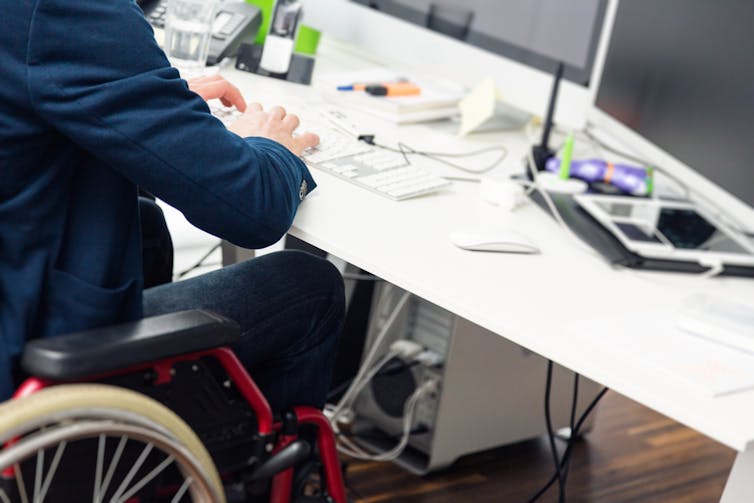
File 20171010 10864 1yj61lu.jpg?ixlib=rb 1.1
 Many workplaces do not make reasonable adjustments for employees with disability.: Shutterstock
               
Simon Darcy, University of Technology Sydney and Tracy Taylor, University of Technology Sydney

Only 53% of Australians with disability are employed, compared to 83% of all working-age people. Australia ranks 21st out of 29 OECD nations when it comes to employment rates for people with a disability.

But looking at the data reveals an even darker story – complaints about disability discrimination are the largest category of discrimination reported to the Australian Human Rights Commission (AHRC), and the numbers have been steady for around 20 years.

Lower employment levels translate into Australians with disability living in poverty at the highest rates in the OECD.

The Australian Bureau of Statistics also found that the employment rates vary radically depending upon the “disability type”. Those who have a “psychological disability”, for example, have the lowest employment rate at 29%.

Employment also varies by “disability severity” (defined as mild, moderate, severe and profound). Employment decreases as severity increases. Only 26% of people with profound or severe physical disability are employed.


As you can see in the chart above, complaints to the AHRC are categorised by the legislation they fall under – Disability Discrimination Act, Sex Discrimination Act, Racial Discrimination Act, Human Rights and Equal Opportunity Commission Act, and Age Discrimination Act.

Using this, we can see that disability discrimination has consistently represented the highest proportion of complaints, currently 37%. When you consider that the Racial Discrimination Act and the Sex Discrimination Act total 41% of cases combined, this gives some insight into the prevalence of workplace discrimination faced by people with disability.

The next chart shows the proportion of disability discrimination complaints that relate to the workplace. This is approximately 35% from the latest figures but  has peaked at a much higher rate.

While we can’t explain the fluctuation, at various times there have been changes to the system, cuts in funding and political tensions. What can be interpreted from the figures is that disability discrimination has been sustained and ongoing over the two decades.


In our research, using publicly available complaint case summaries, we found that employers incorrectly assumed that the costs of employing people with disability were higher than they are, or were unaware of government programs to offset the costs of reasonable adjustments in the workplace. In other cases, people were discriminated against by the strict adherence to guidelines and policies. 

We found several distinctive themes in the disability complaints made.

For instance, many employers do not provide adequate access to the workplace. This could be as simple as tactile ground surfaces for people who are blind. Many cases also involved managers, or human resource procedures, being too quick to dismiss an employee who acquired a disability. Reasonable adjustments can often be made to the position descriptions.

Hiring practices were often biased and discounted the abilities of applicants (otherwise known as unconscious bias). In many cases, workplaces were not inclusive of assistive technologies, such as screen reading software or hearing loops. These would have allowed employees with a disability to do their job.

Mental health complaints have doubled in prevalence over time suggesting the dynamic nature of disability discrimination and the willingness of those with mental health issues to disclose their disability who previously may not have instigated a complaint case.


In reading the summaries of the complaints to the AHRC, it is apparent that employers, co-workers and third-party organisations (e.g. insurance companies) directly or indirectly treat people unfairly, or, in the worst cases, display open hostility to Australians with a disability.

In doing so, those involved show a lack of understanding of the basic legal principles of the Disability Discrimination Act. These include sections covering direct discrimination, indirect discrimination, unjustifiable hardship, inherent requirements and reasonable adjustments.

What can be done?


Some may argue that Australians with severe levels of disability would be unable to work. But their experiences show that, with the correct assistive technology and attitudes that focus on ability rather than disability, employment is not just possible but imperative. 

A recent OECD report singled out Denmark and Switzerland for their targeted intervention for younger people with disability or medical conditions. This ensures they have the highest chances of being employed rather than becoming welfare-dependent.

The foundation of the National Disability Insurance Scheme shows the government’s desire to give people with disability the opportunity to move from welfare to employment. While we wait for the major policy change to take effect, other immediate options are available to bring about positive social change.

Positive exposure in the media (see Attitude Foundation), personal contact and education could change attitudes to disability. The government and non-profit organisations have a multitude of resources available for businesses, to raise awareness about best practice and inclusive assistance.

One good resource is Job Access. This government site provides education and resources to assist with workplace adjustment. It also provides direct assistance to people with disability.

The ConversationOther organisations like the Australian Network on Disability can help businesses to become strategically more inclusive. In the end it will come down to employers giving every Australian job seeker with disability a fair go and not judging “what I can do by what you think I can’t”.

Simon Darcy, Professor of Social Inclusion - UTS Business School - Centres for Business and Social innovation, and Business Intelligence and Data Analytics, University of Technology Sydney and Tracy Taylor, Professor of Sport Management, University of Technology Sydney

This article was originally published on The Conversation. Read the original article.


An article based on work we undertook on the Australian Human Rights Commission's complaint case and conciliation outcomes.
Darcy, S., Taylor, T., & Green, J. (2016). ‘But I can do the job’: examining disability employment practice through human rights complaint cases. Disability & Society, 31(9), 1242-1274. http://www.tandfonline.com/doi/full/10.1080/09687599.2016.1256807
The Conversation

Tuesday, June 20, 2017

Ospitalità Opening doors: how to make hospitality jobs truly inclusive

Innovative Italian and Australian Approaches
Reprinted from https://www.uts.edu.au/about/uts-business-school/management/news/opening-doors-how-make-hospitality-jobs-truly-inclusive 

Hotel Albergo Etico staff receive integrated life skills and vocational training.  Photo: Supplied 

The Albergo Etico in Italy is a hotel with a difference: sprouting from the desire of a group of friends to help one young man find a placement, today the hotel is staffed by people with Down Syndrome training in all facets of the hospitality business.
The hotel is owned and operated by the "Download Albergo Etico" Project, an integrated life skills and employment project for people with Down Syndrome that is garnering interest internationally, including in Australia.
“We aim to make people with Down Syndrome the real protagonists of their working life,” the project’s Chair Alex Toselli says. “I believe people with disabilities must have the same rights to dream, to make money, to drive a car,” he told a recent seminar at UTS Business School.
As well as being paid industry-standard wages, the hotel staff receive integrated life skills and vocational training so they gain a level of independence they can carry with them throughout their lives and careers.
Toselli is now working with groups in Australia, Argentina, Finland, Norway and Slovakia interested in the concept.

'I believe people with disabilities
must have the same rights to dream'

Consultant and former Executive Director of Down Syndrome NSW Tracylee Arestides – who experienced Hotel Etico first-hand last year – recently established Project Etico Australia and is working closely with Toselli on the goal of setting up a hotel here.
“We’ve had a tremendous response across the sector to the whole working, living, learning concept embodied by Project Etico,” says Arestides, a UTS alumna. 
The success of Albergo Etico is largely due to the positive attitudes of, and relationships formed with, the business, hospitality and tourism industries, as well as the local community, Toselli told the “Ospitalità or HospitABLE” seminar at the University of Technology Sydney.
But continued innovation in the hospitality, education and tourism sectors is needed to ensure sustainable and inclusive employment becomes widespread globally, he says.

Debbie and Brendon Coombes have been running a Livvi's Cafe in Blacktown, Sydney.  Photo: Supplied
Australia ranks 21st out of 29 OECD countries when it comes to employment of people with a disability, says Professor Simon Darcy of UTS Business School. Among those of working age, more than half are either officially registered as unemployed or counted as not participating in the labour force.
Discrimination in employment based on disability is a significant issue, as identified in a recent analysis of Australian Human Rights Commission complaints, he says.
Further, due to the history of “sheltered workshops” in Australia, underpayment remains a big problem, along with the amount of time spent looking for work, which is significantly higher among people with disabilities than the non-disabled.
“But we know there are innovative ways to connect training, employment and inclusive approaches to organisational practice and we want to show that people with disability can make long-term and sustainable contributions to Australia economically and socially,” Professor Darcy says.
Australian businesses that do employ people with a disability report greater productivity and higher staff morale.
That’s clearly an opportunity for the hospitality industry, where high staff turnover compromises customer service and sustainability, the seminar heard.

'Australian businesses that do employ
people with a disability report greater
roductivity and higher staff morale'

Social enterprise Livvi’s Café is another group trying to change the employment statistics for people with a disability.
As a social enterprise, Livvi’s Café – an offshoot of the not-for-profit organisation Touched By Olivia – operates under a business model where profits are generated but with the aim of funding social good.
The initial idea of the café chain was to create safe and inclusive play spaces for children with disabilities, founded on the principle that “every child has a right to play”. But the goals soon expanded to include providing employment opportunities for young people with disabilities. 
Chief Executive Bec Ho says the move into cafés two years ago was well received by the community – people were more than happy to wait a little longer for a coffee – and the project is improving the wellbeing and confidence of its young employees.
Aviva Redmond, who works as a service provider with service provider LifeStart and has a close family member with a disability, is excited to see projects like Download Albergo Etico and Livvi’s Café. “It’s really fantastic to see truly inclusive workplaces – workplaces that actually just treat people with disabilities like everyone else and pay them a fair wage,” she says.
Louise Geaghan from Willoughby Council says there’s still a lot of work to be done in Australia but the National Disability Insurance Scheme means Australia is on the cusp of a new world of choice and opportunity.
“As we move away from people with disabilities being in institutions or staying with their family for all of their lives, then we all start to think about them having those needs just like all of us do – and I think that’s really good,” she says.
Byline:
Viki Gerova and Lesley Parker

Monday, November 28, 2016

Seminar on Measuring Destination Competitiveness, Sustainability and Accessibility in Tourism

Masters research candidate Ana Rucci, from the National University of La Plata Argentina, showcased her research on accessibility in tourism at a talk for the UTS Business School, University of Technology Sydney on 17 November 2016. Ana's research aims to develop a uniform methodology that could measure accessibility in tourism as a competitiveness factor across different countries.
Destination competitiveness and sustainability (Ritchie and Crouch, 2003) is a robust framework used by academics and industry to identify competitive advantage by nation states. In 2016 the World Tourism Organization recognised the growing importance of accessible tourism as a commitment to their charter on universally accessible tourism products and services, however, what constitutes accessibility for destinations remains largely unexplored.

Case studies from Argentina and Brazil were a particular focus point in the preliminary findings Ana presented, as the recent FIFA World Cup and Olympic and Paralympic Games boosted tourism in the area while incorporating issues involving accessibility for the host nation and cities. By contrasting these examples in relationship to findings from Australia and New Zealand, Ana's research builds on an examination of overarching tourism destination competitiveness from a disability and accessibility perspective.
Photo 1: Ana Rucci & Prof Simon .Darcy at the UTS Business School

Ana's presentation was part of a larger research project that Ana, Dr Natalia Porto (also from the National University of La Plata Argentina), and Professor Simon Darcy from UTS Business School are undertaking on global accessible tourism metrics and policy.

Seminar on Measuring Destination Competitiveness, Sustainability and Accessibility in Tourism


Masters research candidate Ana Rucci, from the National University of La Plata Argentina, showcased her research on accessibility in tourism at a talk for the UTS Business School, University of Technology Sydney on 17 November 2016. Ana's research aims to develop a uniform methodology that could measure accessibility in tourism as a competitiveness factor across different countries.
Destination competitiveness and sustainability (Ritchie and Crouch, 2003) is a robust framework used by academics and industry to identify competitive advantage by nation states. In 2016 the World Tourism Organization recognised the growing importance of accessible tourism as a commitment to their charter on universally accessible tourism products and services, however, what constitutes accessibility for destinations remains largely unexplored.

Case studies from Argentina and Brazil were a particular focus point in the preliminary findings Ana presented, as the recent FIFA World Cup and Olympic and Paralympic Games boosted tourism in the area while incorporating issues involving accessibility for the host nation and cities. By contrasting these examples in relationship to findings from Australia and New Zealand, Ana's research builds on an examination of overarching tourism destination competitiveness from a disability and accessibility perspective.
Photo 1: Ana Rucci & Prof Simon .Darcy at the UTS Business School

Ana's presentation was part of a larger research project that Ana, Dr Natalia Porto (also from the National University of La Plata Argentina), and Professor Simon Darcy from UTS Business School are undertaking on global accessible tourism metrics and policy.

Wednesday, September 21, 2016

Observations on the Rio 2016 Olympic and Paralympic Accessibility

'Grotesque spectacle'? Rio has a long way to go to become more accessible


Tracey J Dickson, University of Canberra; Jorge Knijnik, Western Sydney University, and Simon Darcy, University of Technology Sydney

It was quite a reality check. With one phrase, “Espetáculo grotesco” (“grotesque spectacle”), Portuguese journalist Joaquim Vieira created a major controversy with his denigration of the Paralympic Games.

Through his choice of words, and his throwback to disability as a “freak show”, he highlights the difficulty of moving the discourse and practice from a medical model to a social approach.

The former sees people with disabilities as abnormal, deviant or inferior, with disability a “personal tragedy”. A social approach focuses on the abilities rather than deficits, challenging the disabling environments, attitudes and behaviours of individuals, organisations and societies.

Without this transformation, the vision espoused in the IPC Accessibility Guide to improve host city accessibility and attitudes towards people with disability will remain a distant aspiration rather than a reality.

The Paralympic Games will never be a panacea for the social issues facing a host city and nation. But can they be a beginning to enabling social, cultural and environmental change?

Focus on accessibility


Rio is a city already facing accessibility challenges. This is after Rio hosted the 2007 Parapan Games and was also involved with the 2014 FIFA World Cup, where accessibility was on the agenda.

The accessibility agenda seeks to be inclusive of the ten different impairment types that compete within the athlete classification system. Yet, accessibility at the Paralympics moves beyond athletes to spectators, officials, employees and volunteers who should be able to move freely, independently and with dignity around the city.

According to the Rio 2016 Accessibility Technical Guidelines, nearly 24% of Brazilians have some kind of disability. So an improvement in accessibility levels not just in Rio, but throughout Brazil, will be one of the biggest and most enduring legacies of the Olympics.

But there are challenges making large cities that have existed for centuries more accessible. Following the 2012 Games, David Bamford noted that London had made improvements to accessibility, particularly with public transport, but there was still more to be done.

For a host city to be accessible for the event and beyond requires a range of facilitating factors, including policies, codes, legislation, funding, strong disability advocacy coalitions and education.

What Rio didn’t need was a downturn in its economy that saw it descend into a recession in the lead-up to the Games, and political turmoil that resulted in the impeachment of its President between the Olympic and Paralympic Games.


              The residences for athletes have good accessibility, but what about the rest of the city?
              OIC


Rio 2016 Paralympic accessibility


Sally Swanson, an architect and registered journalist at the Games, sponsored by Disability Rights Education & Defense Fund, told us via personal correspondence that accessibility was not factored into planning for the Games and was only implemented after the construction was completed. The exceptions she noted were the athlete’s village and the integration of the transportation system.

Together with others on the ground in Rio, we note a few examples that highlight the gaps in planning, design, construction, funding, operations and management of accessibility.

There have been many efforts to enhance accessibility, but existing infrastructure makes universal accessibility difficult. In the Fort Copacabana area, where the triathlon and marathon are held, there are kilometres of black and white “Portuguese pavements”.

These tell some of the history of the land, but in reality, they have not been well maintained. The surface is often undulating, tiles are missing and they are very slippery when wet or sandy.

There are also limited public toilet facilities in Fort Copacabana, none of which are accessible. However, many retail stores and cafes in the area have made an effort to have ramps available to improve access.


              Barriers were placed across access tactile tiles.
              Author provided


There is a new subway line L4 that was 30 years in the planning. It was opened in time for the Games and is for exclusive use of accredited personnel and ticket holders during the event. With 15 new trains, the poster behind the barrier (see image right) boasts “agility is first”, but agility for whom?

There is good lift access and tactile tiles, but when these became active, it is clear that the message has not been conveyed to operational managers as to what tactile tiles are for. Barriers to manage pedestrian flow were placed across the tiles.

Services were also cut back before the Paralympic Games as a cost saving measure.

In Barra Olympic Park, in front of the entry to Main Press Centre, there was a trip hazard that was unmarked. No one seemed concerned, nor was anyone doing anything about it.

As noted by Sally Swanson in personal communication, the curb cuts in the Park were also installed after construction and were not marked for vision-impaired.

At the Rio 2016 Paralympic Opening Ceremony, the final torch bearer who used a wheelchair had to push himself up a ramp that appeared to well beyond the 5-6.25% of incline as recommended Rio 2016 Accessibility Technical Guidelines. Of further concern was whether it was of a suitable surface given the heavy rain that came over the stadium as he ascended the final ramps.

Media coverage


In the week prior to the Paralympic Games, Brazilian mainstream media was mostly highlighting stories about personal triumph, of how Paralympic athletes have suffered and overcame personal barriers to be where they are.

Even with the large number of people with disability in the country, there were no discussions about diversity and social topics surrounding disability. These conversations continue to be omitted in mass media, which appeals only to individual efforts of the “warriors” as the way to overcome hurdles they face due to their disability.

There were a few exceptions, such as the history of Natalia Mayara, a Brazilian tennis player who wants to be acknowledged not by her life dramas but as an elite athlete. These may be indicative that there is room for positive changes in the social imagination.

Despite the media focus on the sentimentality of athletes, the main open TV broadcaster (Rede Globo) has a very weak coverage of the Games. It only broadcasts live on its pay TV channels, which have had a major increase in their audience levels since the start of the Paralympic Games. The broadcast of the Paralympic opening ceremony has broken all audience records on these pay TV channels.

Public TV (TV Brasil) is covering most of the games live, but few people access it,  and the new government after Dilma Roussef’s impeachment is planning to reduce or even to close this very important public vehicle.

Accessibility for tourists


In the lead up to the Games, the IPC ran workshops for tourist organisations and tourism businesses on the opportunities for accessible tourism.

The international media spotlight also brings with it initiatives such as the Accessible Rio City Guide by Lonely Planet. The guide was developed in conjunction with IPC support and is provided free on the Lonely Planet website.


              Old cities often have significant accessibility issues, and Rio is no exception.
              OIC


While developed with the dual idea of servicing both athletes and visitors with disabilities, the guide also provides a certain amount of corporate social responsibility cachet for both organisations.

Historically these types of CSR programs are part of a plethora of strategic alliances that the IPC has worked with in the lead up to the games and announced strategic alliance extensions of during the games.

How will we know if there is an accessibility legacy? Within Rio and Brazil this may involve the improved visibility of people with disability in life but without baseline research on current levels of social participation how will we know improvements have been made? Another KPI might be to look at the growth in competitors and countries at successive Paralympics, if there are more athletes and/or more countries then this might be a signifier of the increasing accessibility of the International Paralympic movement.

Access game changers


One missed opportunity is the training of the 70,000 passionate volunteers as “game-changers” for access. Typically, disability is just a small fraction of the overall volunteer training (which may be less than three days per volunteer). We are not even sure that accessibility is addressed in the training at all.

If volunteers were given more training in accessibility and disability, which could be done very simply and cheaply via online training such as with Vancouver 2010 and Rio 2016, they could also become the “game changers” for access in their communities after the Games.

The volunteers would be able to support accessibility during the games, and then have the knowledge, skills and vision to support accessibility in their communities when they return home, enabling a true accessibility legacy for the host country.

It’s important we remember that accessibility does not happen by accident, it happens by design.

The Conversation

Tracey J Dickson, Associate Professor, Centre for Tourism Research, Faculty of Business, Government and Law, University of Canberra; Jorge Knijnik, Senior Lecturer, School of Education; Researcher, the Institute for Culture and Society, Western Sydney University, and Simon Darcy, Professor & Co-Director  Cosmopolitan Civil Societies Research Centre - UTS Business School, University of Technology Sydney

This article was originally published on The Conversation. Read the original article.

The Conversation

Total Pageviews

Popular Posts

Labels